Why How to Budget Every Two Weeks matters
Paychecks and monthly bills do not line up neatly. That timing gap — not a lack of willpower — is why people feel flush on Friday and stressed by midweek. How to Budget Every Two Weeks is about matching cash to due dates so you stop borrowing from next payday.
Step-by-step budgeting when you are paid every two weeks — caps, bills, and buffers.
Most rent and utilities are monthly. Biweekly pay arrives about 26 times a year; semimonthly arrives about 24 times on fixed calendar dates. If you treat every deposit like “half a month,” you will feel broke in rent week and rich in quiet week — even when yearly income is fine.
The Consumer Financial Protection Bureau’s budgeting advice still applies: list income and must-pay bills first, then adjust spending so the plan stays above zero. Keep a monthly view for fixed costs, then split those dollars across paycheck 1 and paycheck 2.
If you need the monthly foundation first, read how to make a monthly budget, then come back to map it onto your pay schedule. Prefer math first? Try the biweekly budget calculator.
Think of your checking account like a shared calendar, not a scoreboard. Money that is unmarked on Friday will get claimed by the loudest want by Sunday. How to Budget Every Two Weeks teaches you to mark rent, utilities, and grocery buffers the way you would mark shifts at work — as commitments that already belong to someone (Future You).
People who “make enough” still feel paycheck-to-paycheck when due dates cluster. The fix is rarely a viral hack. It is a written assignment for paycheck 1 and paycheck 2, plus a rule for 3-paycheck months so lifestyle does not quietly ratchet up twice a year.
Put this plan into Ziko free. Set income, category caps, and alerts — no subscription, no bank login. Prefer math first? Open a monthly budget calculator.
Create Free Account →Life story: Sam’s “rich Friday / broke Tuesday” month
Sam works a standard job and gets paid every other Friday. One net paycheck is $1,696. Multiply by 26 and divide by 12 and you get a monthly average of about $3,675 — enough, on paper, to cover rent of $1,475, utilities around $164, groceries near $355, a phone bill of $65, car insurance of $115, and still put $125 toward savings.
On paper was not how it felt. Rent clears on the 1st. In months where payday 1 lands on the 28th or 29th, Sam would celebrate, order takeout twice, grab a few “small” Amazon items, and then watch rent + an unexpected utility spike wipe the account before the second deposit. By midweek he feels like he never had money — even though yearly take-home was fine. That mismatch is exactly what How to Budget Every Two Weeks is meant to fix.
The messy month (before a plan)
Friday payday: $1,696 hits. Checking balance looks healthy. Sam tells his self, “I’ve earned a break,” and spends $220 on food delivery and a night out over the weekend.
The following Tuesday: groceries + gas take another $303. Nothing is “wrong,” but the cushion that should have been reserved for rent is already thinner.
The 1st: rent $1,475 drafts. The account dips near zero. Sam transfers from a nearly empty savings pot (or floats a card) and promises to “be better” after the next check — which arrives mid-month already half-committed to catching up.
The same income, rebuilt around due dates
Sam kept the same job and the same pay. What changed was the story he told the money on payday morning — before apps and impulse spending got a vote.
- Paycheck 1 assignment (~$1,696): rent $1,475 + half utilities $82 + grocery buffer $178 + transport $125 = $1,860 reserved first → about $0 left for wants that period
- Paycheck 2 assignment: remaining utilities, phone $65, car insurance $115, second grocery half, dining cap $180, savings $125 ≈ $745 planned on purpose
- Rule Sam wrote on a sticky note: “Flexible money is whatever is left AFTER assignments — not whatever is in checking on Friday night.”
The first two weeks felt stricter. The third week felt calmer. By the second full month, rent week stopped being a crisis because the cash had been labeled before it could vanish. That is the practical heart of how to budget every two weeks: timing and labels, not a bigger salary fantasy.
When a rare 3-paycheck month showed up, Sam kept paycheck 1 and 2 on the same baseline and sent most of paycheck 3 to savings and a small car-repair sinking fund — instead of permanently raising dining. The “bonus” month finally funded goals instead of a higher lifestyle floor.
A month in Luis’s life (detailed)
Here is how Luis’s month feels once How to Budget Every Two Weeks is in motion — same pay, less panic.
Week 1 (payday + rent pressure)
Paycheck $1,465 lands. Before celebrating, Luis moves rent money (or confirms it is already reserved), sets aside half utilities and a grocery buffer, and only then looks at dining. Weekend plans fit inside what is left — not inside the whole deposit.
Week 2 (the quiet danger zone)
No rent draft this week, so the account looks “fine.” This used to be when Luis overspent. Now a per-paycheck grocery/dining cap keeps the second half of the month from being robbed. He checks remaining flexible money on Wednesday night.
Week 3 (second payday)
Second deposit arrives. Phone, insurance, remaining utilities, savings transfer $200, and the second grocery half get assigned first. Luis logs anything that surprised his — a medical co-pay, a school fee — and adjusts next period’s caps instead of pretending it did not happen.
Week 4 (review + reset)
Ten-minute review: which paycheck felt tight, which category blew, whether a due date should move. Luis does not rebuild the whole system. He changes one assignment and carries the rest forward. Calm compounds.
Decision moments (what changed the outcome)
Budgets are made in tiny conversations with yourself. These are the moments that usually decide whether how to budget every two weeks works this month.
-
Moment: “I got paid — I can afford this weekend.”
What Aisha did instead: Aisha opened the paycheck assignment first. Rent and grocery buffer were already labeled. Weekend money was only the leftover $542.
-
Moment: “I’ll catch up on the next check.”
What Aisha did instead: She treated that sentence as a warning light. Borrowing from the next deposit was how the broke-Tuesday cycle started — so she cut dining that week instead.
Worked example (copy the pattern)
Here is a full monthly picture you can copy and rewrite with your rent. Priya nets $1,523 every two weeks. Yearly take-home is $1,523 × 26 = $39,598. Monthly average is ÷ 12 ≈ $3,300. Rent is $1,150 on the 1st.
Monthly plan (the “why”)
- Rent $1,150
- Utilities $180
- Groceries $410
- Transport $120
- Phone + insurance $160
- Savings $225
- Dining/fun $160
Paycheck 1 (covers rent week)
Reserve $1,545 first: rent $1,150 + half utilities $90 + grocery buffer $205 + transport $100. Leftover for wants this period ≈ $0 — not the whole paycheck.
Paycheck 2 (covers the back half)
Remaining utilities, phone/insurance, second grocery half, dining cap $160, savings $225. If anything is left, Priya sends it to a sinking fund — not an automatic lifestyle upgrade.
Copy the assignment logic for How to Budget Every Two Weeks, not the exact dollars. Your city will differ; the payday labels should not.
Another real-life example (different situation)
Contrast case: Priya is paid semimonthly (1st and 15th), not biweekly. She gets 24 paychecks a year, so the ×26÷12 formula would overstate income. Priya splits monthly bills across the two fixed dates instead — rent from the 1st paycheck, smaller bills from the 15th — and still uses per-period grocery caps. Same guide idea as How to Budget Every Two Weeks, different calendar math.
Takeaway: diagnose your pay schedule before you copy anyone’s spreadsheet. Biweekly and semimonthly feel similar and budget differently.
If your numbers differ, keep the decision pattern: write the facts → assign the money before it vanishes → review on a fixed day → adjust one thing. That pattern transfers across incomes, cities, and pay schedules.
Do this week (so it becomes real)
Reading is not the plan. Finish these four actions in the next seven days — then use the interactive tool and checklist below to lock it in.
- Open your last two pay stubs and circle the net (take-home) amount.
- Write every bill due in the next 30 days with the calendar date.
- Assign each bill to paycheck 1 or 2 — then set grocery caps per paycheck.
- Create matching categories in Ziko and turn on one alert under 100%.
Step-by-step: how to do this
Follow these steps in order. Each one is small enough to finish in one sitting — together they create a plan you can keep. Read the life scenario above once, then execute the checklist as you go.
-
1
Confirm your pay schedule
Biweekly means every 14 days (~26 checks a year). Semimonthly means two fixed calendar dates (~24 checks). If pay always lands on the 1st and 15th, you are semimonthly — use a two-paycheck monthly split, not a 26-paycheck average. Getting this wrong breaks every formula that follows.
-
2
Convert pay to a monthly average
Use take-home pay only. For biweekly: (net paycheck × 26) ÷ 12. Example: $2,000 × 26 = $52,000 → about $4,333/month. That monthly number is what you use for rent, insurance, and savings targets — even though cash arrives in two-week waves.
-
3
List bills with due dates
Write rent, utilities, insurance, phone, minimum debts, and must-pay subscriptions with the day money leaves. Due dates decide which paycheck funds them. Separate fixed vs variable so groceries do not compete with rent in your head.
-
4
Assign bills to paycheck 1 vs 2
Bills due in the first half of the month usually come from the deposit just before them. Later bills come from paycheck 2. Goal: each 14-day window covers its own obligations without borrowing from the next deposit.
-
5
Set per-paycheck variable caps
Groceries, dining, and fun money work better as paycheck (or weekly) caps than one giant monthly number you blow in week one. After fixed bills and savings, split what remains on purpose.
-
6
Review every payday
Five minutes on payday: what cleared, what is due before the next deposit, how much flexible money remains. This habit prevents the classic trap — feeling rich on Friday and short on Tuesday.
Interactive planner
Use the tool below to turn this guide into numbers for your situation. Change the inputs and watch the results update — then copy the result into your Ziko categories.
Try it: biweekly pay → monthly average
Common mistakes (and what to do instead)
These are the patterns that quietly undo good intentions. If you recognize one, fix that first before adding more rules.
- Treating two paychecks as “half a month”. Biweekly is 26 deposits a year. Use the ×26÷12 average for monthly bills, then assign cash by due date.
- Spending the third paycheck as lifestyle. Keep a two-paycheck baseline for bills; send the extra to debt, savings, or a planned treat — on purpose.
- One monthly grocery number only. Split flexible spending per paycheck or week, or you front-load the month and feel broke later.
- Ignoring due dates when assigning bills. A bill due on the 3rd must be funded by the paycheck that lands before the 3rd — not “sometime this month.”
- Skipping payday reviews. Month-end is too late. Five minutes on payday catches shortfalls while you can still adjust.
Checklist (interactive)
Check off each step as you complete it — progress saves in your browser.
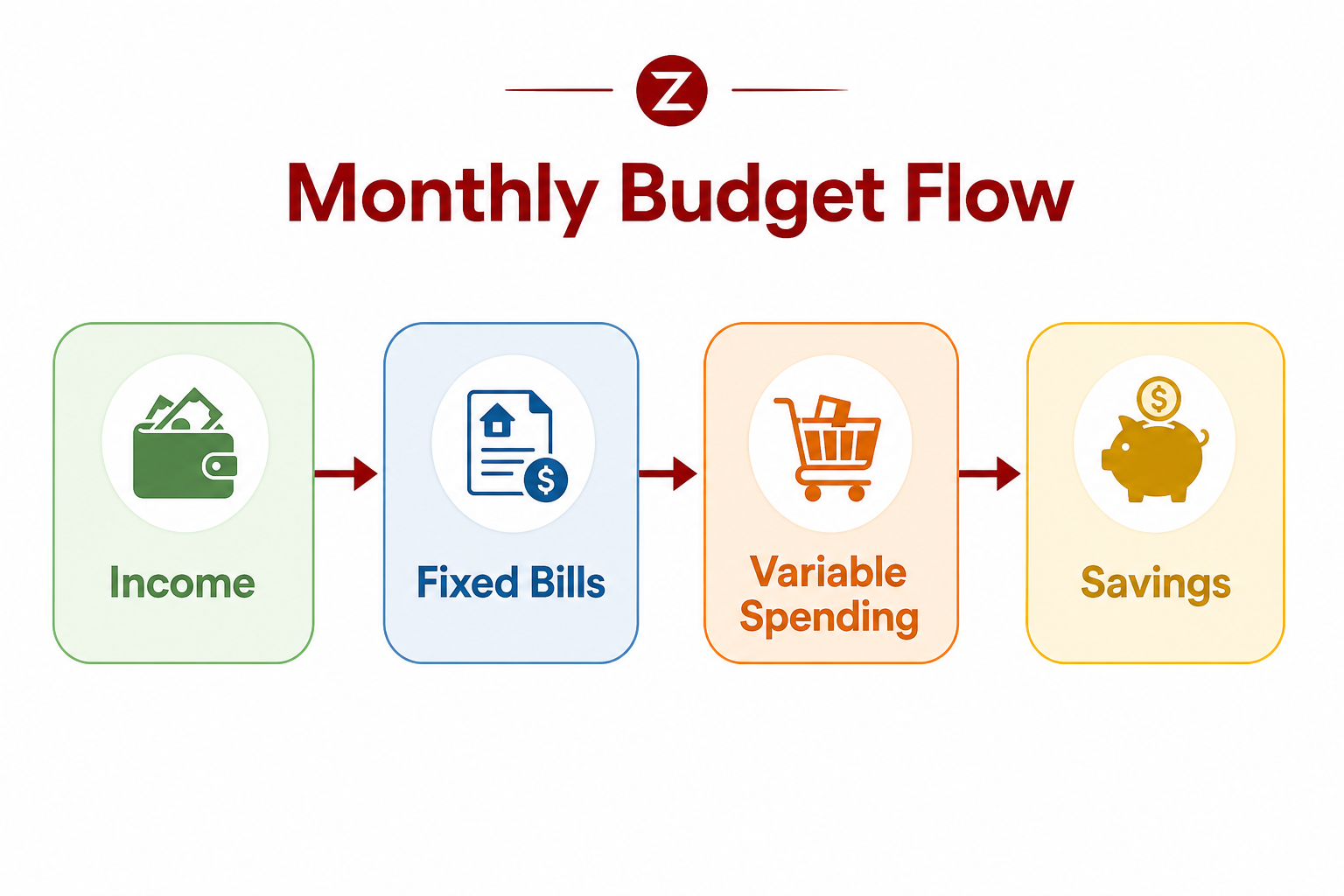
Ready to track it weekly? Ziko mirrors this structure: income → caps → categories → alerts.
Create Free Account →Video guides (learn visually)
Budgeting Basics: How to Create a Budget and Stick to It · Watch on YouTube
How To Stop Overspending Money · Watch on YouTube
Comments & discussion
Share a real number from your plan — income, rent, or the cap you set — so others can learn from it.